My lunch hour was spent at the library. I should have been undergoing an x-ray for my foot (or going to communion, but I was allowed lunch too late) but the allure of bound volumes was too great. I, of course, picked up a few historical novels, but found myself wanting to challenge my mind after allowing it to lay in fallow for so long. I wandered up to the philosophy section to look for one of my favorites - Fear and Trembling by Soren Kierkegaard (my copy is missing!). Unfortunately, I couldn't find it, but I did discover the Essay Collection: Faith, Christianity and the Church by C.S. Lewis, and another that I've been wanting to read for a while - Charles Taylor's A Secular Age. With all of these lovingly stacked in my arms (I forgot my book bag), I strolled back to work in my polka dot dress, bobbing my head to the Bravery. I looked oblivious and silly and book-worm-ish, but didn't care one bit (though I did incur many stares).
I was planning on carrying CT home (It is unfortunate that the name 'Charles Taylor' can mean either the dictator or the lovely philosopher. The first time I heard his name without condemnation, I was shocked. And then I realized it was in reference to a frail old white Canadian man, almost the oxymoron of the tyrant - there could not be two more different people with the same name.); but then I realized that his book was heavy enough to use for self-defense - not a brick that I was really inclined to take all the way home with me, even though I had told David Parker we would expound on his thoughts the next day (on Facebook of all places - can you tell how busy I am at work?). So I settled and brought C.S. Lewis with me. I sat on the bus and listened to the burr of a Scot's voice tell stories to his children across from me, an old man try to start up a conversation with a young hipster girl beside me, and the soft lull of Spanish from the group of teens behind me. At that moment, I read "The Grand Miracle" - lovely.
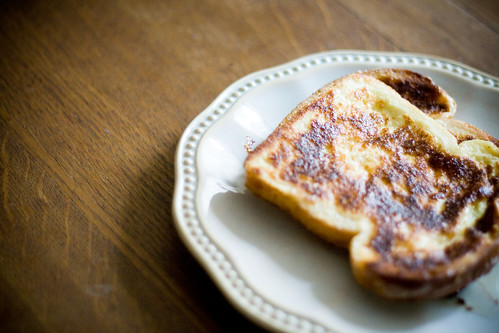
If I was to choose either to sit down with though, it would be K., mostly because I imagine him eating french toast. So, to relate, in my own weird way and to turn my day on its head, I decided to make breakfast for dinner. It turns out that comfort food really does . . bring you physical comfort (Pascal should have tried some french toast). Like any good food that has lasted for centuries, french toast started out as the food of the poor. In Medevial times, old stale bread was combined with eggs to use up whatever ingredients could be found to feed the family. However, contemporary 15th century cookbooks also talk about the recipe with the crusts removed and listing expensive ingredients, such as cinnamon and almond milk, - definintely something that a starving family wouldn't do. This was a dish enjoyed through every strata of society - it was a comfort to all who partook. It was also experienced in many different countries, under varying names. In France it was called 'pain perdu' or 'lost bread' - it was only the Americans in the 19th century who coined the phrase 'french toast'.
So, last night, I imagined sitting down with Kierkegaard (while I was reading C.S. Lewis) and enjoying some french toast with him. I had a conversation with both that night, and felt content with fluffy, eggy bread in my stomach. However, as much as they arm me with the tools to find the ethereal, neither could come to my bodily defense like CT could - if I ever find myself in a sketchy area of town, I'll be sure to bring A Secular Age for armament.

1 c. half and half
3 large eggs
1/4 tsp. salt
pinch nutmeg
1/4 tsp. cinnamon
2 tsp. vanilla extract
1 tbs. white sugar
1/8 c. all purpose flour
8 slices stale bread - sourdough is the best for this
4 tbs. unsalted butter
1. Preheat oven to 375F. In medium mixing bowl, whisk together the first 8 ingredients - if you find the flour just won't mix, throw it all in the blender for about 30 seconds. Pour it into a pie pan and put it to the side.
2. Dip bread into the mix in the pie pan and let it soak for about 30 seconds on each side. Place aside on a cooling rack, with something underneath to catch the drips.
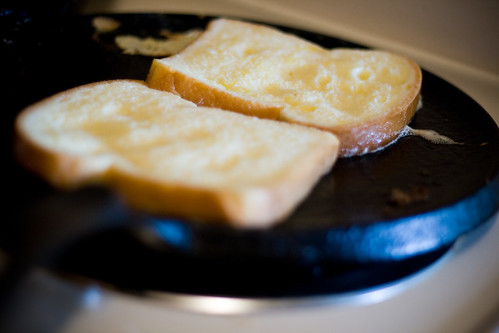
3. On the stove, over medium-low heat, melt 1 tablespoon of butter on a skillet (this is where I adore my cast-iron skillet - thanks mom for parting with it). Put 2 pieces in and cook on either side until golden-brown - about 2-3 minutes per side. Remove from pan and put in the oven for about 5 minutes (this time also depends on how crispy you and your guests like the outside of your french toast - each to their own slices). Repeat with all the bread. Serve immediately!
4. Pray. Eat. Read this quote with a smile.
2. Dip bread into the mix in the pie pan and let it soak for about 30 seconds on each side. Place aside on a cooling rack, with something underneath to catch the drips.
3. On the stove, over medium-low heat, melt 1 tablespoon of butter on a skillet (this is where I adore my cast-iron skillet - thanks mom for parting with it). Put 2 pieces in and cook on either side until golden-brown - about 2-3 minutes per side. Remove from pan and put in the oven for about 5 minutes (this time also depends on how crispy you and your guests like the outside of your french toast - each to their own slices). Repeat with all the bread. Serve immediately!
4. Pray. Eat. Read this quote with a smile.
"To reach the positions held by the real scientists – which are then taken over by the Myth – you must – in fact, treat reason as an absolute. But at the same time the Myth asks me to believe that reason is simply the unforeseen and unintended byproduct of a mindless process at one stage of its endless and aimless becoming. The content of the Myth thus knocks from under me the only ground on which I could possibly believe the Myth to be true. If my own mind is the product of the irrational – if what seem my clearest reasonings are only the way in which a creature conditioned as I am is bound to feel – how shall I trust my mind when it tells me about Evolution?"
(C.S. Lewis, "The Funeral of a Great Myth," Essay Collection: Faith, Christianity, and the Church (London: HarperCollins Publishers, 2002): 28.


.jpg)
